
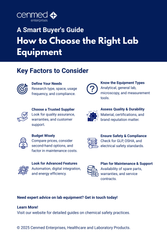
How to Choose the Right Lab Equipment for Your Needs
8th Apr 2025
A well-outfitted lab is essential for performing precise and swift experiments. The importance of selecting the most suitable lab equipment cannot be understated as it aids in maximizing the process while also complying with certain safety and quality standards. You would be managing the best grade medical lab, research/emergency and educational supplies — you need the right medical laboratory and scientific instruments supplies. This guide walks you through these important factors and how to make the right purchase decision.
1. Define Your Laboratory Requirements
Before buying lab equipment, it is preferable to evaluate the lab itself and answer the following questions to ensure:
1. What type of research or analysis will be conducted?
2. What are the space limitations in your lab?
3. How frequently will the equipment be used?
4. Are there any compliance or safety regulations to consider? By answering these questions, you can make a list of basic laboratory supplies which are necessary for your demand.
2. Research Lab Equipment Types and Features
Laboratory instruments are designed to assist in specific tasks, and it is necessary to understand this and use the right one. The main categories are:
- Analytical Instruments: Spectrophotometers, chromatographs, and titrations for chemical analysis.
- General Lab Equipment: Centrifuges, autoclaves, and water baths for sample preparation and sterilization.
- Microscopy Equipment: Optical, electron, and fluorescence microscopes for imaging and analysis.
- Measurement Instruments: Balances, pH meters, and thermometers for precise readings. One should also look at the specifics of the instruments such as accuracy, resolution, automation level, and the possibility of other lab systems.
3. Choose a Reputable Supplier
Choosing a responsible seller is crucial to ensure the high quality of the lab equipment to invest in. The following are the characteristics of a reliable supplier:
- Give laboratory tools that are branded and verified by reliable manufacturers.
- Give guarantees and help customers in case of a need after the sale of products.
- Be well-received by customers and have endorsements to prove it.
- Deliver quick and knowledgeable assistance. Looking out for various suppliers and their offerings will help you find the most competitive price, and the best quality item.
4. Consider Quality and Durability
Why invest in lab equipment that will not be durable enough? One thing that comes to mind is the usage of disposable lab consumables. You can always evaluate the quality and the long-lastingness of the product through the following factors:
- Quality of Material: Either three materials-stainless steel, borosilicate glass, and high grade plastics are the ones that ensure availability in the long run with their being of such unaffected quality.
- Production Regulations: It is important that the equipment participating in this phase complies with the company's regulations and standards such as ISO, CE, or FDA.
- Prestige of the Trademark: Companies that have strong and proven brands in the market are those that usually produce goods that match customer expectations and are long-lasting as well.
5. Assess Budget and Cost-effectiveness
One of the aspects that need to be taken into account is the high cost of lab equipment. Budget is usually the primary constraint deciding a consumer’s choice among otherwise available product options. You can adhere to the given advice list while trying to combine the two factors of price and quality:
- Check out prices from various sellers.
- Think of buying second-hand laboratory equipment to save money.
- Go for quantity discounts while making the purchase.
- Take results and maintenance and usage costs into account to compute the total cost of ownership. In this way, by correctly forecasting your resources, you can get the instruments you need for research without spending too much.
6. Ensure Compliance with Safety Standards
Safety is a key aspect of lab equipment choice. Check for the products to be in line with the latest safety standards in the industry and the following:
- Ventilation and exhaust systems must be equipped for fume hoods.
- Electric safety must be certified.
- It is imperative that the products are in compliance with GLP (Good Laboratory Practices) and OSHA. The adherence to these standards supports the internal employee in taking the proper safety measures and the superior safety of the working environment.
7. Look for Equipment with Advanced Technology
Technological progress has been very beneficial in the laboratories. If you are buying a lab equipment, you need to check the functions of it such as:
- Automation: Lowers the number of manual errors and raises the output of the operation.
- Digital Integration: Switch to cloud-connected instruments that are intelligent enough to provide a solution for remote monitoring.
- Energy Efficiency: Green lab equipment also saves on operational costs and the environment. Going for modern scientific instruments that are upgraded increases not only accuracy but also the efficiency of research and operations.
8. Check Maintenance and Support Options
For lab equipment to last longer regularly, they should be given proper care. The factors below should be taken into account before you make a purchase:
- Availability of spare parts and consumables.
- Ease of maintenance and calibration.
- Warranty duration and terms.
- Availability of customer support and service contracts. Keeping the instruments maintained appropriately is highly important not only for lab functionality but also for enhancement of lab equipment life cycles.
9. Read Customer Reviews and Case Studies
User reviews and case studies provide insights into the functionality and performance of lab equipment. You can gather the feedback of the following aspects:
- Reliability and durability.
- Ease of use and installation.
- Technical support and service quality. This information helps in making a well-informed decision.
10. Plan for Future Expansion
By mapping the growth of your laboratory, you can also understand your further equipment requirements and the specifics of exactly what kind of additional laboratory equipment you will need. The tips for scalability include:
- Go with the type of gadgets that are upgradable in the future.
- Make sure your system can be modified to be used with later technological devices.
- Buy lab equipment that is versatile so you can use it for other purposes and thus need less space and cost. Thinking ahead of time, you can build a more adaptable laboratory that can also grow.
Conclusion
It is of great importance to choose the right lab equipment because it is a decision that greatly influences the efficiency, safety, and success of laboratory operations. How well the lab's specific needs are understood, the type of scientific instruments researched, supplier reliability considered, and safety standards compliance ensured is the criteria for making an excellent purchase of those instruments. Investing in first-rate laboratory materials improves not only the results of the research but also your future costs.
You have to get in the habit of browsing through several alternatives before you finally decide on the equipment that will suit your laboratory, taking the time to select the best equipment to meet your laboratory's needs is time well spent. If, for instance, you need some high-tech equipment for experiments, or you need general lab equipment, or you're into biotechnology and have to work with specialized scientific tools, whatever your choice will be, outreach that would lead to efficiency in the lab is very important and will guarantee you a safe working environment.