
Stop Hemorrhaging Budget: Why Consolidated Lab Equipment Maintenance Matters
5th Jan 2026
Managing laboratory equipment maintenance shouldn’t feel like managing dozens of vendors. Yet many labs still juggle separate service contracts for centrifuges, HPLCs, freezers, flow cytometers, and mass specs, each with its own renewal dates, paperwork, and service process.
This fragmented approach quietly drives up costs, slows repairs, and increases compliance risk. In an era where laboratory operational efficiency is paramount, sticking to the traditional multi-vendor service model is no longer sustainable. Lab managers are increasingly tasked with doing more with less, yet the administrative hours spent chasing down technicians for specific instrument brands bleed valuable resources. When your procurement team is buried under a mountain of disparate invoices and your lab manager is stuck on hold with customer support, the science suffers. It is time to rethink how we approach the lifecycle management of critical scientific assets.
The Hidden Cost of Fragmented Service Contracts
Every additional service agreement adds administrative burden and delays when equipment fails. In regulated environments, downtime isn’t just inconvenient, it can disrupt assays, delay trials, and create SOP deviations.
The financial impact extends far beyond the sticker price of the repairs. Consider the "soft costs" associated with vendor proliferation. When you manage individual contracts with Original Equipment Manufacturers (OEMs), you are paying a premium for brand exclusivity rather than service efficiency. Furthermore, without a centralized view of your assets, you lack leverage. You might be paying for a premium 24-hour response contract on a freezer that holds non-critical samples, or conversely, relying on a "time and materials" model for a critical mass spectrometer that has a high failure rate. This misalignment between asset criticality and service level is a classic symptom of fragmented maintenance strategies.
Under a fragmented model, Mean Time to Repair (MTTR) increases due to vendor qualification checks, one-off purchase orders, and scheduling delays across multiple OEMs.
The result: more downtime and less operational control.
This delay is often exacerbated by the rigid structures of large manufacturers. If the specific OEM technician for your region is booked, your equipment sits idle. There is no flexibility to deploy a qualified alternative. In contrast, a consolidated strategy focuses on the outcome, getting the instrument running, rather than the source of the technician. By removing the administrative hurdles of setting up new vendors for every minor repair, labs can significantly compress the timeline from "breakdown" to "bench-ready."
One Agreement, One Point of Control
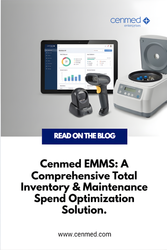
Cenmed’s Laboratory Equipment Maintenance Management Solution (EMMS) replaces dozens of service contracts with one consolidated agreement covering all lab equipment, regardless of manufacturer or age.
This vendor-agnostic approach is the cornerstone of modern scientific asset management. Whether you are running Agilent HPLCs, Thermo Fisher incubators, or Beckman Coulter centrifuges, the process remains identical. We act as the single shield protecting your lab from the chaos of the external service market. This consolidation eliminates the "invoice fatigue" that plagues accounts payable departments, condensing hundreds of transactions into a single, predictable monthly or quarterly statement. It simplifies budget forecasting, transforming variable maintenance spikes into a fixed operational expense (OpEx).
When equipment goes down, your team makes one call. Cenmed deploys the right technician from its pre-qualified network of OEMs and Independent Service Organizations (ISOs), reducing repair time, administrative work, and compliance risk.
Our dispatch team utilizes a rigorous vetting process to ensure that only certified, experienced engineers touch your sensitive equipment. This hybrid model allows us to leverage the best available resource. If an ISO engineer can arrive within 4 hours and has the requisite certification, we deploy them. If the repair requires proprietary OEM software, we manage that OEM engagement for you. You never have to worry about the logistics; you simply receive a notification when the technician is en route and another when the job is done.
Regain Control of Tail Spend
Unplanned repairs and small service calls, often referred to as tail spend, are one of the biggest hidden budget leaks in laboratory operations. Cenmed EMMS captures these fragmented transactions and routes them through a single, compliant system.
Tail spend is notoriously difficult to track because it often falls below the capitalization threshold or procurement audit triggers. It’s the pipette calibration services, the emergency incubator repair on a weekend, or the replacement of a specialized rotor. Individually, these costs seem negligible. Collectively, they can account for up to 20% of a lab’s maintenance budget. By aggregating this spend, Cenmed provides the data necessary to negotiate better rates and identify assets that are becoming financial black holes due to frequent, low-cost failures.
The result is better spend visibility, fewer unvetted vendors, and stronger GxP compliance without added workload for procurement teams.
From Reactive to Predictive Maintenance
By consolidating maintenance data across all assets, Cenmed EMMS enables a shift from reactive repairs to data-driven, predictive maintenance. Labs gain visibility into downtime trends, repair costs, and asset performance, supporting smarter replacement and CapEx decisions.
In a fragmented system, data is siloed. You might know how often one specific HPLC fails, but you lack a holistic view of your entire chromatography fleet’s reliability. Our EMMS platform aggregates service history, creating a comprehensive Total Cost of Ownership (TCO) profile for every asset. This data is crucial for audit readiness. When a regulatory body requests maintenance logs for a specific study, you don’t need to hunt through filing cabinets for vendor-specific work orders. The digital trail is centralized, standardized, and instantly retrievable. This moves your lab from a posture of "putting out fires" to one of strategic foresight, allowing you to retire assets before they jeopardize your compliance status.
A Smarter Way to Manage Lab Assets
Consolidated maintenance isn’t just about saving money, it’s about running a more reliable, compliant, and efficient lab. With Cenmed EMMS, teams stop managing contracts and start managing assets.
The modern laboratory cannot afford to be bogged down by legacy maintenance models. The friction caused by managing multiple vendors is a choice, not a necessity. By streamlining your service strategy, you liberate your scientists to focus on innovation and your operations team to focus on growth. Whether you are a small biotech startup scaling up or a large pharmaceutical enterprise looking to optimize global sites, the solution lies in unification.
Ready to simplify your lab maintenance strategy?